His tablet bears the future but concealed,
His pen is calm if good or bad we yield.
The powers gave us proper share at first,
With grief or strife no less nor more we wield.
Archieven
Saidi, A.
On Tablet writ whatever was to be,
And good or bad the Pen wrote the Decree;
On Day of Qismet all the lots were cast –
Our grief and struggle are but vanity.
Thompson, E.F.
O, Heart! Since earth’s truth is illusion vain,
Why so distressed in lasting grief and pain?
Bear trouble ! Bow to Fate ! Once gone the Pen
For thee will never trace the scroll again!
Roe, G.
Ere yet the dawn of Azal shed its light
O’er dreary chaos and the realms of night,
The Pen, unmoved by good and evil, wrote;
Nor grief can change, nor endless toil rewrite.
McCarthy, J.H.
O heart, my heart, since the very basis of all this world’s gear is but a fable, why do you adventure in such an infinite abyss of sorrows? Trust thyself to fate, uphold the evil, for what the pencil has traced will not be effaced for you.
Garner, J.L.
Whatever is, by Fate was erst designed,
The Maker now his Labor has resigned,
And all our Striving can avail us Naught,
For all our Acts were long ago defined.
Rubáiyát of Omar Khayyám of Naishápúr

Rubáiyát of Omar Khayyám of Naishápúr. – [S.l. : s.n.], 1923. – [34 p.], 26 cm.
Printed by Joh. Enschedé en Zonen, Haarlem.
“The second Munich Print. The Rubáiyát of Omar Khayyám translated by E. FitzGerald according to the 4th edition has been printed in two hundred numbered copies in the Fleischman Antiqua by Joh. Enschedé en Zonen in Haarlem in the summer 1923 for the Verlag der Münchner Drucke in Munich. The numbers one to ten were handbound in coloured parchment. This is copy number: …”.
Rubáiyát of Omar Khayyám
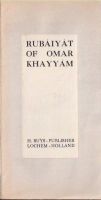
Rubáiyát of Omar Khayyám. – Lochem : Buys, [ca. 1938]. – 32 p., 18 cm.
‘Tekst’ (p. 5-30); ‘Note’ (p. 31)
“This edition of the Rubáiyát of Omar Khayyám is reprinted from Edward FitzGerald’s translation published in 1859; published by H. Buys, Lochem, Holland and printed by the N.V. Lochemse Handels- en Courantendrukkerij from the Century type, numbered 1-1800, six copies beyond commerce.”
Niet alle exemplaren zijn genummerd.
Rubaiyat of Omar Khayyam
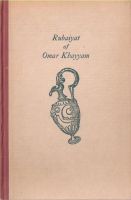
Rubaiyat of Omar Khayyam. [Den Haag : Boucher, ca. 1941]. – 20 cm., 34 p.
“The glossary has been taken from “The Rubaiyat” edition of 1919 (Messrs. Fouls (sic.)) The text has been reprinted from FitzGerald’s translation published for the first time in 1859.”
‘Aantekening: De aantekeningen werden ontleend aan de Engelse uitgave van 1919. In een oplage van 300 exemplaren gedrukt door N.V. Mouton & Co. te ‘s-Gravenhage. De tekening op de band werd ontleend aan G. Simenon: Princelycke Devijsen, Antwerpen 1563’. (De Jong, 619).
Tijdens de bezetting clandestien gedrukt door Mouton, uitgegeven door L.C.J. Boucher. Typografïe van Henri Friedlaender, letter is Electra (van Dwiggins)
Rubáiyát of Omar Khayyám
Rubáiyát of Omar Khayyám. [Amsterdam : Balkema], 1944. Printed by Joh. Enschedé en Zonen, Haarlem. – [26 p.], 19 cm.
“This is one of twelve pulls on decent paper made by l.C. and G.W.”
‘Aantekening: Herdrukt naar de eerste druk van de vertaling van Edward FitzGerald. Alle exemplaren werden gedrukt op Barcham Green door N.V. Joh. Enschedé en Zonen te Haariem en in perkament gebonden door I. Brandt en Zoon te Amsterdam, gebonden door J. Brandt en Zoon te Amsterdam. (De Jong 620).
I.C. = Jan van Krimpen, G.W. = G.M. van Wees.